Introduction
Head lice infestation, medically known as pediculosis capitis, is a common parasitic condition caused by Pediculus humanus capitis, an insect that lives on the human scalp and feeds on blood. Although head lice generally do not transmit diseases, infestation can cause scalp itching, discomfort, sleep disturbance and considerable social stigma, particularly among school-aged children.
Several misconceptions exist regarding the causes and transmission of head lice. These include beliefs that wearing jasmine flowers causes infestation, that lice jump between people, that swimming pools transmit lice, and that pets can spread human head lice. Understanding the biology, life cycle and transmission of this parasite helps distinguish scientific evidence from unsupported claims.
1. Does Wearing Jasmine Flowers Cause Head Lice?
In some communities, it is believed that wearing jasmine flowers (mallipoo) in the hair can cause head lice infestation. However, there is no established scientific evidence that wearing jasmine flowers causes head lice.
Head lice infestations occur when live lice are transferred from an infested person to another person. Transmission occurs primarily through direct head-to-head contact, which allows lice to crawl from one person’s hair to another’s.
Flowers themselves are not an established cause of head lice infestation. Therefore, the belief that wearing jasmine flowers directly causes lice should not be presented as a scientifically proven fact.
2. Can Head Lice Jump or Fly From One Person to Another?
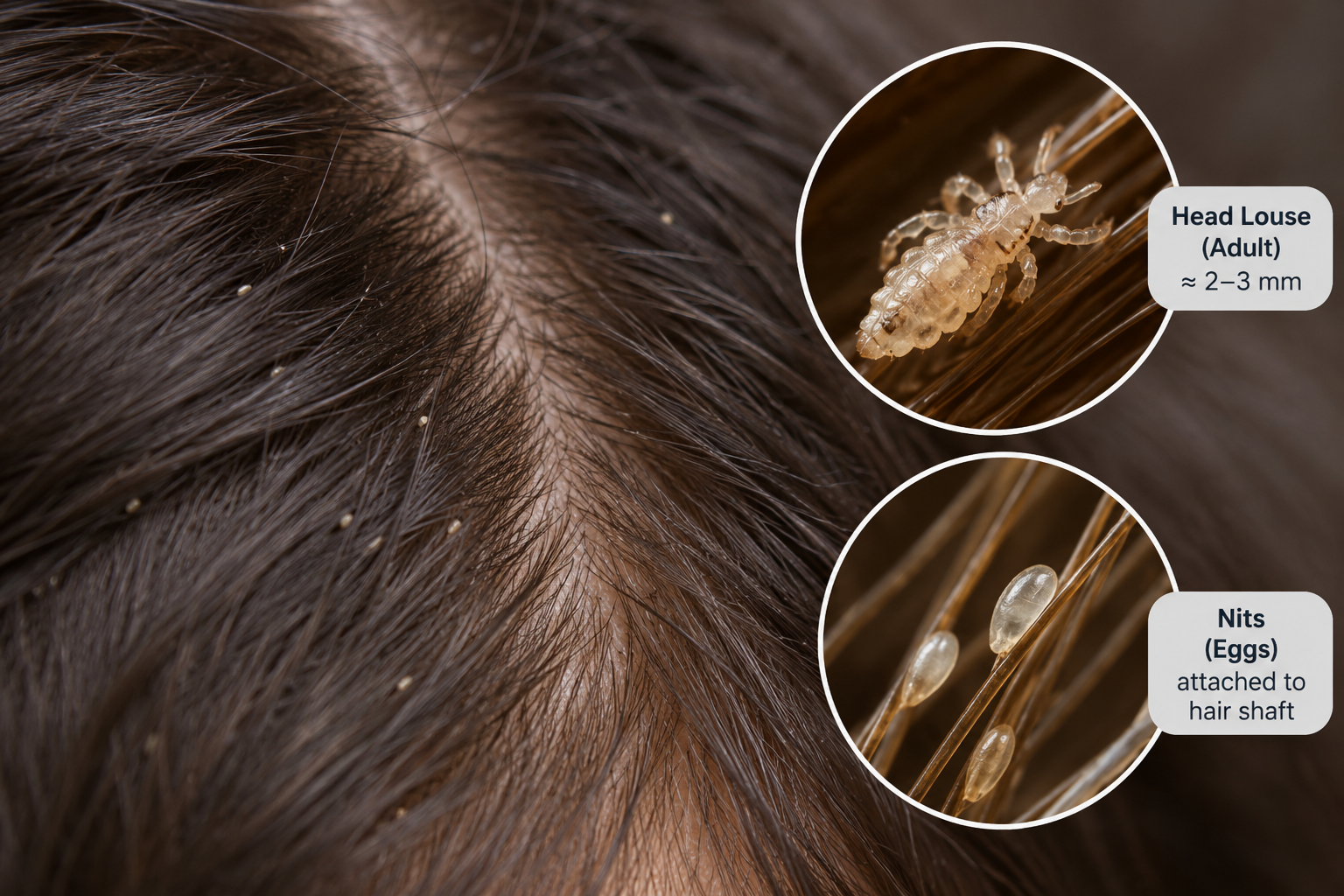
Head lice are small, wingless parasitic insects. Adult lice are generally approximately 2–3 mm long and have six legs arranged in three pairs. Their legs are adapted to grip human hair, allowing them to crawl along individual hair shafts.
Unlike fleas, head lice cannot jump. They also cannot fly because they do not have wings. Their primary mode of movement is crawling.
According to the Centers for Disease Control and Prevention (CDC), transmission most commonly occurs when the hair of an infested person comes into direct contact with another person’s hair. This is why head-to-head contact during play, close interaction and other activities can facilitate transmission, particularly among children. (CDC)
Transmission through shared personal belongings, including combs, brushes, hats and towels, is possible but less common than direct head-to-head contact.
3. Can Swimming Pools Spread Head Lice?
Swimming pools are not considered a common route of head lice transmission.
According to the CDC, head lice can survive underwater for several hours, but they are unlikely to spread through swimming-pool water. Their ability to grip human hair firmly helps them remain attached to the scalp, even when the person is swimming. Furthermore, chlorine concentrations used in swimming pools do not reliably kill head lice. (CDC)
However, sharing towels, combs or other personal belongings that have recently come into contact with an infested person’s hair may occasionally contribute to transmission.
Therefore, it is scientifically accurate to state that transmission through swimming-pool water is unlikely, rather than claiming that it is completely impossible.
4. Can Dogs, Cats or Other Pets Transmit Human Head Lice?
Human head lice are adapted to living on humans and feeding on human blood. Dogs and cats do not acquire or transmit human head lice.
Some animals have their own species-specific lice, but these parasites are biologically distinct from human head lice.
The American Academy of Pediatrics confirms that head lice are specific to humans and cannot be transferred between humans and pets. Consequently, treating household pets for human head lice is unnecessary and inappropriate. (American Academy of Pediatrics)
5. Do Head Lice Prefer Dirty Hair?
Head lice infestation is not an indication of poor personal hygiene or an unclean environment. Lice can infest people regardless of their socioeconomic background, hair-washing habits or the cleanliness of their surroundings.
Frequent shampooing does not reliably prevent infestation because ordinary hair washing does not necessarily eliminate lice or their eggs. Transmission depends primarily on exposure to live lice, particularly through direct head-to-head contact.
The American Academy of Pediatrics reports that head lice infestation has not been shown to be significantly influenced by hair length or frequent brushing and shampooing. (American Academy of Pediatrics)
Therefore, a person with clean hair can acquire head lice just as easily as someone who washes their hair less frequently. The presence of lice should never be used to judge an individual’s cleanliness.
6. Where Do Head Lice Live, and How Do They Reproduce?
Head lice primarily live on the human scalp and hair, where they obtain blood meals. They are commonly detected around the nape of the neck and behind the ears.
Female lice attach their eggs, commonly called nits, firmly to individual hair shafts using a glue-like substance. Because the eggs are firmly attached, ordinary washing or brushing may not remove them effectively.
According to the CDC, eggs typically hatch within approximately 6–9 days. The young lice, called nymphs, undergo several developmental stages before becoming adults, usually within about another week. Adult lice can live on the human head for approximately 30 days, and females can lay several eggs daily. (CDC)
If an infestation is not appropriately managed, the life cycle can continue, allowing the number of lice to increase.
Scalp itching occurs primarily because of an immune response to substances introduced during louse feeding. However, itching may not develop immediately after the initial infestation. During a first infestation, symptoms may take approximately 4–6 weeks to become noticeable.
Itching alone does not confirm head lice. Direct identification of a live louse is the most reliable way to establish an active infestation.
7. Does Cutting the Hair Completely Prevent Head Lice?
Cutting the hair short does not guarantee protection against head lice. Although hair length may influence how easily lice are detected or removed, head lice can infest hair of different lengths and types.
The American Academy of Pediatrics reports that head lice infestation has not been shown to be significantly influenced by hair length. Shaving or cutting the hair is therefore not a necessary or guaranteed method of preventing infestation. (American Academy of Pediatrics)
More appropriate measures include checking the scalp when exposure is suspected, reducing direct head-to-head contact when practical, and treating confirmed infestations using appropriate methods.
Complete head shaving is generally unnecessary for treating head lice. Evidence-based treatment and careful combing can help manage infestation without requiring drastic changes to a person’s appearance.
8. Are Coconut Oil, Vinegar and Mayonnaise Reliable Treatments?
Coconut oil, vinegar and mayonnaise are commonly promoted as home remedies for head lice. However, traditional use or widespread popularity does not establish that these substances reliably eliminate live lice and viable eggs.
The American Academy of Pediatrics discusses alternative approaches, including occlusive substances such as mayonnaise and various oils. However, evidence supporting many home remedies remains limited, and their effectiveness cannot be assumed to be equivalent to that of appropriately selected treatments. Vinegar has not demonstrated a reliable clinical benefit for loosening the substance that attaches nits to hair. (American Academy of Pediatrics)
Treatment should be selected according to the individual’s age, the presence of an active infestation, product safety and applicable clinical guidance.
Appropriately selected medicated preparations, known as pediculicides, may be used when indicated. The product’s instructions should be followed carefully because some treatments require a repeat application at a specified interval.
A fine-toothed lice comb can help identify and physically remove lice and eggs. Wet combing may also be used as a treatment approach, provided it is performed carefully and repeated according to an appropriate schedule.
Avoid applying petrol, kerosene, household insecticides or products intended for animals to the scalp. These substances can cause serious harm and are not appropriate treatments for human head lice.
If treatment fails, the diagnosis is uncertain or the scalp develops signs of infection due to scratching, consult a qualified healthcare professional.
Conclusion
Head lice infestation is a common and generally manageable condition that should not be associated with shame or poor hygiene. Scientific evidence establishes that head lice have six legs, cannot jump or fly, and spread primarily through direct head-to-head contact. Human head lice are not transmitted by dogs or cats, and swimming-pool water is an unlikely route of transmission. There is also no established scientific evidence that wearing jasmine flowers causes head lice.
Ordinary hair washing does not reliably prevent infestation, and shaving the head is not necessary for treatment. Similarly, popular home remedies should not be assumed to be effective without adequate evidence.
Accurate health education should focus on identifying live lice, understanding transmission, reducing unnecessary stigma and using appropriate treatment methods. Understanding the biology of head lice helps replace unsupported beliefs with practical, evidence-based measures.
Literature References
1. About Head Lice – Centers for Disease Control and Prevention (CDC), 2024.
2. Head Lice – Pediatrics, American Academy of Pediatrics, 2022. DOI: 10.1542/peds.2022-059282.